
Setting the Stage for Wheeling’s Homeless Taskforce
Courtesy of Kate Marshall
In June, Mayor Denny Magruder announced the formation of a new taskforce to address the issue of homelessness in Wheeling. Magruder said the taskforce will be “guided by local clerics” and is intended to “balance compassion with accountability.” At the time of publication, the council has released little information about the makeup and specifics of the group aside from its chair – Rabbi Joshua Lief of Temple Shalom. As Wheeling’s ‘Homeless Taskforce’ takes shape, Mustard Seed Mountain reflects on the last decade of advocacy for our homeless neighbors.
For the last decade, Wheeling has faced similar challenges as cities and small towns across the country. Regional deindustrialization and the opioid epidemic set the stage for large spikes in poverty rates and homelessness. Local policy exacerbated the housing situation – in 2016, the city banned boarding houses and began seizing and demolishing hundreds of houses, which continues today. In 2019, Ohio Valley Medical Center closed, taking its inpatient psychiatric care facility with it. At least five regional shelters and rehabilitation facilities have since closed, either intermittently or permanently.
First Wheeling Camp Sweep
As homelessness increased and homeless people became more visible, cities including Wheeling increasingly turned to “sweeps,” essentially bulldozing encampments. Then, in 2020, the COVID-19 pandemic descended on the world.
On March 23rd, 2020, governor Jim Justice declared a statewide shelter in place order for all West Virginians as COVID infections and deaths began to rise. That April, the city conducted their first documented camp sweeps. At that time the American Civil Liberties Union of West Virginia called on the city to cease sweeps, especially during the shelter in place.
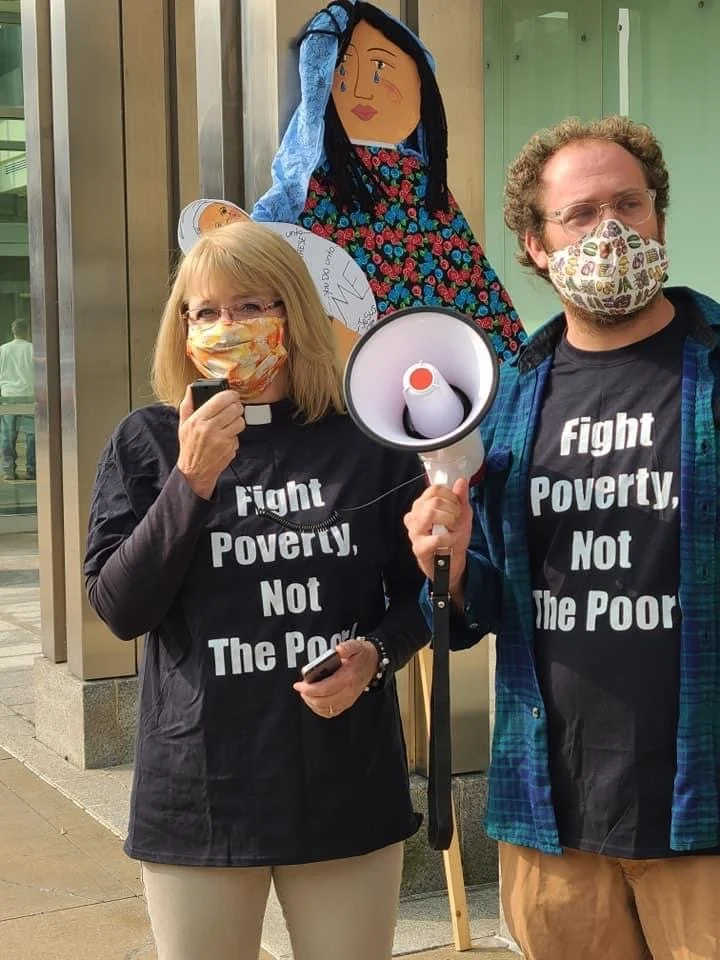
In September, a second round of sweeps was met with an injunction by a federal judge that led to the establishment of a formal eviction procedure with a written two-week notice. Advocates including faith leaders gathered in front of Wheeling’s federal courthouse to demonstrate in solidarity with their neighbors.
From 2020-2023 as the pandemic wound down, the city directed camping under the Rt 250 overpass on 18th Street, allowing service providers easy access to residents needing care. However, by the end of 2023, this camp was closed and the city directed individuals sleeping outdoors to camp in the woods on Vineyard Hill.
During this time the city created the Homeless Liaison position, though it was dissolved in 2024. The position did however spur the creation of the Life Hub. Now a year-round shelter, the Life Hub began operating out of the former First English Lutheran Church on 15th Street as Wheeling’s Winter Freeze Shelter, which had moved through several locations.
Second Sweep
In October 2023, as the camp grew and officials reported complaints about residents, the city moved to sweep Vineyard Hill, again during a winter-weather emergency. Bulldozers arrived on site while snow was falling and residents were out at breakfast. Advocates, clergy and volunteers lent hands to document the demolition and help neighbors remove whatever belongings they could.
As the demolition moved forward, Wheeling City Council introduced a formal city-wide camping ban, eventually passing the ordinance amidst heated public discourse. Joining more than 100 municipalities across the country to pass camping bans in the past three years, Wheeling effectively made it illegal to be homeless. The ban criminalizes sleeping, cooking, and storing belongings on public property, threatening fines and jail time for basic human activities.
More than a dozen faith leaders, individuals, and organizations, doctors, mental health professionals, and service providers signed on to a formal letter to the city opposing the camping ban as unconstitutional, inhumane, and ineffective at addressing homelessness.
The Exempted Camp
In 2024, with the help of the ACLU, faith leaders and organizers again fought in the courts and won their unhoused neighbors a single exempted campsite. The city directed Wheeling’s homeless citizens to camp along the maintenance trail at the end of McColloch Street in Fulton. After five months, the city ordered the camp to move again, this time to Peninsula Street next to the sanitation department’s garbage transfer station.
But in December 2025, lacking camp management, the City of Wheeling decided to close their exempted homeless camp. This announcement came after the Grant’s Pass supreme court decision, a landmark case allowing cities to enforce camping bans by ruling that they do not violate the eighth amendment. The closure of Wheeling’s exempted camp displaced approximately 75 individuals, again during a winter weather emergency. Elected leaders justified the closure by blaming and deriding Wheeling’s charities.
In July 2026, Magruder announced a “crackdown” via increased arrests and surveillance, and the creation of the clergy-led homeless task force.