
Demanding Due Diligence: Warwood Organizes Against a Data Center
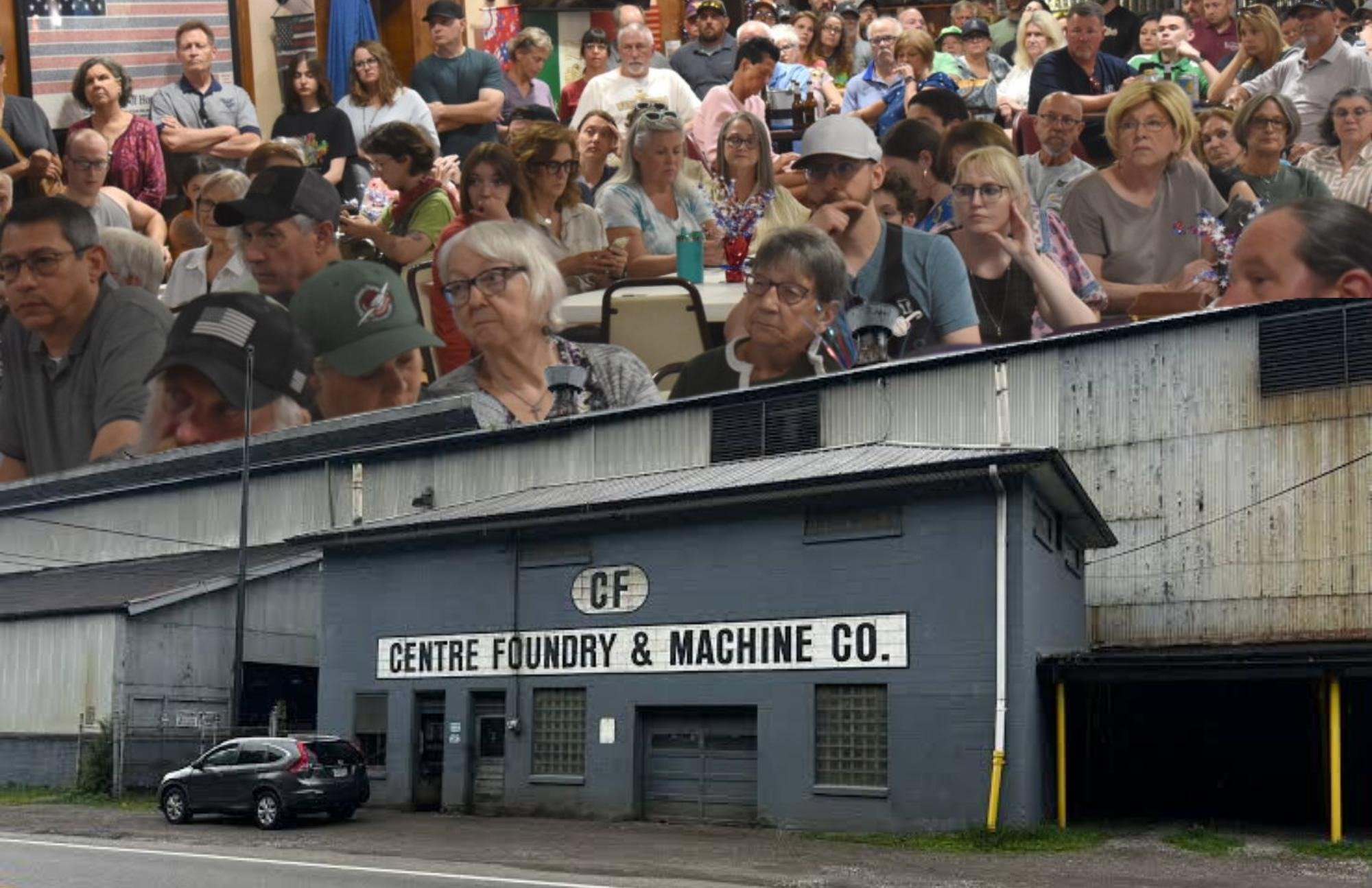
As the sun rises over Ohio County, J. Arnold steps out her front door overlooking the southern portion of Warwood, a Wheeling neighborhood two miles north of the city’s urban core. It’s a quiet neighborhood, all things considered. Arnold can see the mighty Ohio River with the town of Martins Ferry, Ohio, to the west. Through her neighbor’s yards, she can see a shopping complex close enough to hear conversations held in the parking lot. South of the former Save-a-Lot, Arnold sees the historic Centre Foundry and its gray-blue walls.
When Arnold first bought her home, Centre Foundry was still an operating steel mill – the same steel mill that lasted some 183 years since its founding before West Virginia was even a state. In 2023, the foundry quieted as its furnaces ran cold, parking lots emptied, jobs evaporated, and its doors closed for one final time. Now, a new business is preparing to move in; and it’s a neighbor Arnold, and other Warwood residents, are concerned about.
In May 2026, a post by Stokes Inc. – a South Carolina-based company boasting its “Grid Scale Battery Storage, Data Centers, and Energy Systems” – appeared on the business-focused social media platform LinkedIn announcing the sale of Centre Foundry to Silicon Foundation – a company dedicated to building artificial intelligence, or AI, data centers. It took a month for locals to notice the post boasting plans for a 100 megawatts, or MW, data center in Warwood.
But what is a data center, anyways?
Since the inception of the internet, data centers have served to connect individual networks, store valuable data, and process requests to stream videos or view photos or send funds or open webpages. In recent years, though, these data centers have ballooned to encompass an ever-expanding field of AI processing.
The specifics are pretty simple, actually. Data processing requires data processors, and AI requires more and more data processing to complete its ‘tasks.’ When – or, fingers crossed and more accurately, if – you ask Chat GPT or Google’s Gemini or Twitter’s Grok “when did the United States declare independence from the Kingdom of Great Britain, that request is sent to a physical machine. That machine hosts connections to a web of artificially-derived intelligence, cross-referencing your query to information gleaned from every corner of the internet and produces a response often within seconds.
These machines do not possess magic ability, but instead require mechanical inputs. They exist in building housing other machines, often hundreds or thousands, spanning up to thousands of acres in the largest ‘data centers.’ With your request comes an expense of electricity to power the machine and light the facility, and an expense of water to cool the machine and the facility, and an expense of pollution as data centers are more often than not powered by fossil fuels, and thereby an expense of air and soil due to the byproduct.
Where once AI simply removed the background from an image or transcribed an audio recording, it is now generating movies and event flyers and websites and songs and recipes and ‘art’ pieces and other complex, time-and-data-consuming projects.
According to a report by MIT Technology Review, AI text generation uses the same energy as running a microwave for eight seconds. Image creation expends energy equivalent to the use of a microwave for five-and-a-half seconds, while a five second generated video consumes as much energy as a microwave uses for over an hour.
As millions of people begin to use generative tools more frequently, these demands translate directly into more data centers. And that’s where Warwood re-enters the conversation.
Was it 100 MW, or 50 MW, or 30 MW, or 20 MW, or…
As mentioned, Stokes Inc. promoted Silicon Foundation’s purchase of Centre Foundry by saying the site would be capable of hosting a 100 MW facility. That number is important as, above 90 MW, local control would be completely stripped and replaced by state ‘oversight’ thanks to HB 2014, a bill adopted by the West Virginia Legislature in 2025 and signed into law by Gov. Patrick Morrisey shortly thereafter.
In late June 2026, posts on Facebook began to circulate screenshots of Stokes Inc’s since-deleted LinkedIn post. Warwood residents were quick to share their disagreements. A town hall was called days after word began to spread, and local leaders addressed these initial concerns from their weary, confused, and disgruntled constituents.
What came quickly after were community strategy-planning meetings, conversations between elected officials, local bureaucrats, and company representatives, and a contentious city council meeting. Through all of that, the 100 MW promise dropped to a maximum of 50 MW, and quickly dwindled down to an initial 10 MW with the potential to expand up to 50 MW, maybe 100 MW. The point being, a lot of information has been thrown around at such a pace that even the most educated on the situation can find themself whiplashed.
Sense of belonging, fear of betrayal
When Arnold moved to Warwood, she quickly fell in love with the atmosphere around her.
“Something about the environment there, being across from the river… it’s a pretty quiet area. When I walked outside it felt peaceful,” Arnold said of her neighborhood. “I love being outside. The neighbors are great. I love that there’s a farmer’s market. I love the walking trail by the river. And that’s what made me close on that particular house.”
When asked about how she sees her life now, Arnold waxed poetic with a smile beaming ear-to-ear. Then, we brought up the proposed data center. The mood shifted immediately to concern, to confusion, to worry and doubt.
“I am by no means an expert, but I am very concerned about past precedents in other communities,” Arnold said. “And seeing what has been done to them, what they were promised versus what they were then given, what their recourse is when something goes wrong, it really concerns me.”
The “flip-flopping” as Arnold described the changes in Silicon Foundation’s desires for the site caused her to conclude that the company has not fully thought out what was going there, or that due diligence had not been done prior to work commencing – and Arnold says she now sees people coming and going inside Centre Foundry, apparently working on the project.
And that lack of transparency has caused Arnold to question the ethics of the project itself.
“I don’t think that there is a world in which this company has the community’s best interest at heart. If you’re going to start your business in a community, I think the ethical thing to do is to make sure you’re a good fit for the community, to reach out, to take it upon yourself to say ‘hey, this is who we are, this what we’re doing here,’ because, you know, that would the very minimum I would expect,” Arnold said. “I don’t foresee myself staying in Warwood if this becomes a large-scale data center, but we’ll see.”
The people, united…
Arnold is not alone in her concerns. The impromptu town hall previously discussed saw dozens of community members turn out on a dime. The city council meeting similarly saw dozens attend, with sixteen people signing up to speak when, normally, maybe one or two individuals do so. The strategy-planning meeting saw at least one hundred people. Another Wheeling City Council meeting was similarly filled with those in opposition to the data center – some of whom called on the council to place a moratorium on data centers while sorting out what specific powers they have.
Polly Barks has been one of the people working to organize citizens against the data center proposal. Like Arnold, Barks bought a house in Warwood and quickly fell in love with the community surrounding her.
“It feels like a smaller town vibe within Wheeling which I really like. After doing some work here and getting to know people, every time I walk down the street I see someone I know. When I go into the Cheese Melt somebody’s talking to me. At the farmer’s market, always chatting. I know all the grocers at Kroger. It’s just, I don’t know, it’s a good place,” Barks said.
While she’s on the northern side of the neighborhood, about a mile and a half away from Centre Foundry, Barks sees this project as a threat to the community she has grown to love.
“We’ve had coal, we’ve had all this mining, we’ve had fracking. We know how these companies work,” Barks said. “They overpromise, they underdeliver, they strip all the natural resources and all the good things out of a community, and then dip out when the money’s gone. So, it’s not shocking to me at all that [Silicon Foundation] lied and backed off on their original plans.”
While Barks, like Arnold, and like many in Warwood, remains in the dark about what is really happening at Centre Foundry, she has found a silver lining in Silicon Foundation’s now-proposed 10 MW facility: a chance for locals to be heard.
As mentioned, a facility above 90 MW sees local control stripped in favor of state regulation. Under that threshold, local authority remains and leaders, who represent a handful of thousands of people rather than tens or hundreds of thousands, or even millions, are more accessible, more pliable, more reluctant to take action in the face of pushback.
Despite that accessibility, though, Barks and her colleagues are continuing to organize citizens to remain vigilant. She pointed to the area’s House of Delegate member Shawn Fluharty who, after the initial town hall, apparently told residents there was nothing they could do to push back.
“And my thought was, well, that’s bullshit,” Barks said in response. “The next day I had about 20 to 25 people in my living room and we just wrote out ideas and we had 10 projects going within 24 hours of that town hall.”
While this issue has caused a lot of confusion and dismay, there is still hope for Warwood. This grassroots campaign to push back against the data center has seen community members from all walks of life join together on this issue, something Barks sees as incredibly powerful.
“I think we have a lot of people that are rightfully angry and have the organizing capacity and the tenacity to get the job done, but it’s going to be kicking and screaming from the elected officials,” Barks said. “We employ them. I don’t think they know that, that the people are their employer and that their job is not to make decisions for us … it’s to listen and advocate for what we want.”