
Director’s Desk: Issue 8
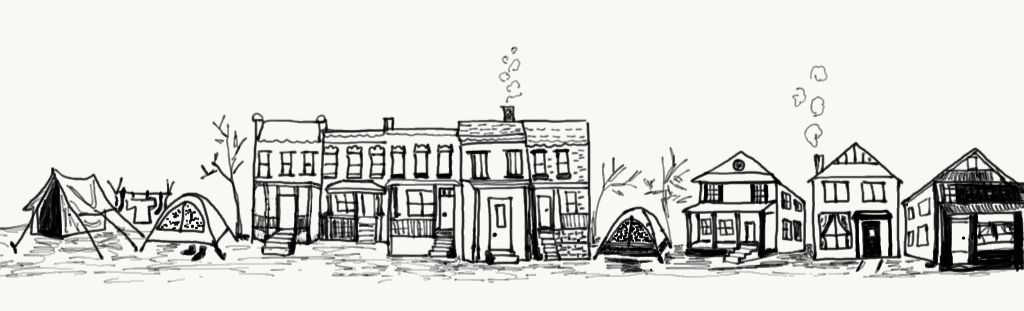
Recently, the City of Wheeling announced the creation of a “Homeless Task Force” and, more recently, announced that Rabbi Joshua Lief would serve as chair of the committee and as one of several faith leaders. This is a very helpful lens to bring to conversations about homelessness for many reasons, especially when the stigma of being “homeless” often comes with being dehumanized for lacking one main material thing – money. But it is not money that gives human life value – or at least it shouldn’t.
Almost all faiths, Jewish, Christian, or otherwise, include mandates that prioritize care for the poor as a primary tenet of faith. In fact, most faiths mandate that money be used to serve humanity, rather than humanity be used to serve money. In my faith tradition, this is called “Option for The Poor and Vulnerable.” It states that if the scales must tip to serve a poor human or create a situation where more money can be made at the detriment of the poor human, we must choose the side of the poor human. But that is not the end of the story – we must then ask why they are poor and what injustices propelled them into the situations those experiencing poverty find themselves in.
While we certainly would have to refer to the wise Rabbi to understand the depths of the Jewish command of Tzedakah, from what I understand, the obligation to care for the poor is not just “charity” but an act of justice and of restoring a level of care that brings about a more fair world. The other thing that I think is very insightful is that Tzedakah offers an understanding of the arch of merit by defining the eight levels of sharing. It starts with the one who gives begrudgingly out of guilt and moves up to the highest level, which I find so intriguing: helping a person become self-reliant, without the need for charity, or even making them a partner in an endeavor that alleviates them from poverty. This is so fascinatingly beautiful to me because what often happens to those experiencing poverty is the exact opposite of “partnership” in any form. Typically, those experiencing homelessness are all too familiar with rejection and being unwanted. This can then either cause mental health issues or addiction, or exacerbate the wounds they already suffer from.
After over a decade of working with those experiencing homelessness, I can say that the greatest poverty that I watch people experience is not the lack of a house or money, but the lack of inclusion. Listen, read, watch, and pay close attention to how those experiencing homelessness are discussed and treated. Too frequently, there is an otherness, frequent rejection, and the wish for these community members to simply disappear. Rarely have I heard the word “partnership” when conversations about “the homeless” or “the poor” occur!
Yet I can also say that when we hold those who are hurt in God’s highest regard, the world changes for individuals and communities. After over a decade of watching pharmaceutical companies target West Virginians and orchestrate an epidemic of addiction, I understand that Substance Use Disorders (SUD) exist because injustice exists. I have witnessed those who are drowning in so many injustices that rarely get recognized because they are rejected and labeled an “addict” before questions can even be asked. Yet year after year, as many people of goodwill tried with all their might to help in the aftermath of the opioid epidemic that was unleashed on our communities, the work was a hamster wheel. It seemed no matter what we did, WV still remained the state with the most overdose deaths and SUD rates.
Until one day, a shift occurred, and our understanding of healing graduated to a higher level. Instead of just working for those experiencing SUDs, we NEEDED to work in partnership with their expertise to heal and move forward.. Those who have experienced addiction had something to share. We started hiring those with histories in SUD as peers to guide social service providers and to accompany those in active addiction in their journey to recovery. They had insights we never considered and fresh ideas that were realistic and creative. It has worked so incredibly well, with such amazing results that many of those first helped by “Peers” are now “Peers” themselves helping others find recovery. This year, the Wheeling Chief of Police, Shawn Schwertfeger could not even believe the impact that has come about since they adopted a “Peer Model” as well.
It has proved over and over again that “There is nothing about us, without us” not only brings about a more just world but is also the most efficient model for creating community change.
I say all of this because the new “Homeless Task Force” states they will have those with lived experience in homelessness on it. I truly hope this is an opportunity for real partnership and true inclusion in a conversation where they are often the foremost experts, rather than tokenism.
To those on the “Homelessness Task Force”, especially the faith leaders: I ask you to please be on guard and remember to listen, read, watch, and pay close attention to the subtle and not-so-subtle ways rejection and the pushing away of the “other” start to creep in … Because it is in that space poverty and a greater need for charity are increased, not decreased. However, with true partnership, a new reality can be achieved where everybody gains.
Homelessness is a complex situation in which symptoms are typically addressed before the root causes. This could be a real opportunity to listen and understand what actually causes homelessness more deeply. We know there will be much work to do in many areas, but with the hope that such partnerships will occur, we believe this could be pivotal in demonstrating that the “Homeless Task Force” is working towards a community where those with the least are not considered “the least.”
Kate Marshall