
“Neighbors Helping Neighbors”: What is Mutual Aid?
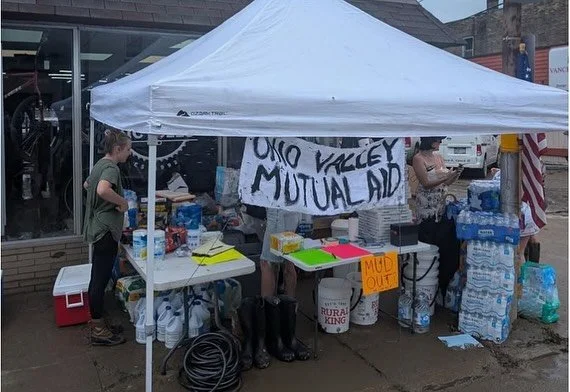
Photo courtesy of Ohio Valley Mutual Aid
Mustard Seed Mountain’s editor sat down for an interview with Ohio Valley Mutual Aid (OVMA) volunteer and organizer Libby Horacek to discuss mutual aid: what it is, what it entails, and how you can get involved.
Q: Who are you and how did you get involved with mutual aid?
A: I’m Libby Horacek. I’m an organizer with Ohio Valley Mutual Aid. I’m a leader in that I’ll come up with an idea and follow it through, but we’re a leader-forward organization. The idea is that as many of us as possible should be leaders of the organization and coming up with projects to work on and taking initiative.
Q: How did you get involved with mutual aid work?
A: I have been inspired and amazed by stories of mutual aid since not long after Hurricane Katrina because there was an amazing organization working down in New Orleans called Common Ground that organized people there to help their neighbors.
When I lived in New York I got involved with my Brooklyn neighborhood’s mutual aid group that was helping people during the COVID-19 Pandemic, so we just did things like buy and deliver groceries or I would pick up my neighbor’s medication, things like that. That’s where I started learning about doing mutual aid in groups. One thing is that all of us do mutual aid all the time. So I’ve always done casual mutual aid but when you’re organizing it with other people, that’s a whole separate ball game.
I got involved with OVMA in January of 2025 [when I saw another member at a party and they encouraged me to go to a meeting].
Q: What is a brief history of mutual aid?
A: As far as I know, the term mutual aid goes back to maybe the late 1800s. There’s a writer – Peter Kropotkin – who wrote a book, “Mutual Aid as a Factor of Evolution.” Sometimes when we’re talking about mutual aid we’re talking about an organization that helps neighbors help other neighbors and sometimes we’re talking about just the basic impulse of living creatures to help each other survive because that is a factor in all of our survival – our survival as a species. That’s the origin.
Neighbors helping neighbors has always been something that marginalized people do because they don’t have access to the same resources from the state and from huge institutions so they’ve got to cooperate to cobble together what they can to survive. “Mutual aid” is just kind of giving a name to that and the set of practices common to the current movement – decentralized leadership and collective decision making – have helped it really be powerful.
Q: What types of things fall under the mutual aid umbrella and what exactly is it?
A: Broadly speaking, anything that we’re doing to help each other survive is mutual aid and everybody does it. I mean, nearly everybody. I’m sure there’s some people who are living in a cave somewhere who are not helping their cousin clean out their garage – but I think all of us have this experience of wanting to help each other and benefitting from it.
When we’re talking about it as a movement, mutual aid incorporates work with an ethos of ‘solidarity not charity.’ We are at the same level. I’m helping you as a neighbor. I’m not helping you because ‘I have more than you’ or ‘I am better than you, you are a poor, unfortunate person and I am somebody who knows what you need and can give it to you.’ Instead it’s like ‘you are a part of my community and it benefits me to help you.’
Q: How is mutual aid different from other charitable organizations?
A: Because we want everybody to be more or less on equal footing we really want to be accessible to people joining in and taking part in decision making and deciding what we do. A lot of nonprofits have a professional class who knows how things are done in that world because it does take a lot of expertise to know how to do all the paperwork and understand insurance and taxes and all of that stuff. So there’s sort of this professionalization of ‘you have to have training’ and ‘you have to express yourself in a professional manner or you don’t belong here.’
Mutual aid really tries to break down that barrier and instead be like ‘you are an expert in what you need, so if we’re going to help you, it would be great if you could be a part of our community and we can all help each other.’ And I think that's pretty different from most nonprofits.
Q: What work does Ohio Valley Mutual Aid do?
A: The biggest and most obvious one is the flood relief from last summer. We organized hundreds of volunteers and helped out hundreds of neighbors by mucking out their basements. We were only able to do that because we already had the trust with each other and knew each other from previous work we had done doing much simpler things like community kitchens, clothing swaps, tabling at events. We still do all of those things.
One thing that we are thinking about right now is how do we prepare for the next disaster – climate change is happening so we can expect there is going to be more flooding. So it’s ‘how can we be ready for that and get infrastructure in place to help next time.’
Right now the goal is to have events and get those relationships in place so that we have trust and know who to talk to.
Q: What did the flood relief efforts teach you about mutual aid and its importance in Wheeling?
A: It is that element of having the relationships in place and having trust with each other, because you are going to be really stressed out if you don’t have that safety with each other, and then you can’t take risks. It was a huge risk for us to organize volunteers to go into people’s flooded homes; that was really scary and difficult. When I was the one volunteering it was really scary to be like ‘I’m putting myself into a situation where I’ve got to trust these people to take care of me.’ So I think the relationships are the biggest thing.
Q: How do I get involved with mutual aid?
A: We have a website where you can sign up for our mailing list. You can follow us on social media: we're on Facebook and Instagram.
The most important thing is that we have public events. We try to have at least one every month and you can come to one of those and talk to us. Like I said, it’s all about relationships, so we want to know who you are, and we want to meet you, and then you can come to one of our meetings. We want more people to be involved, so please come out!