
Finding Common Ground
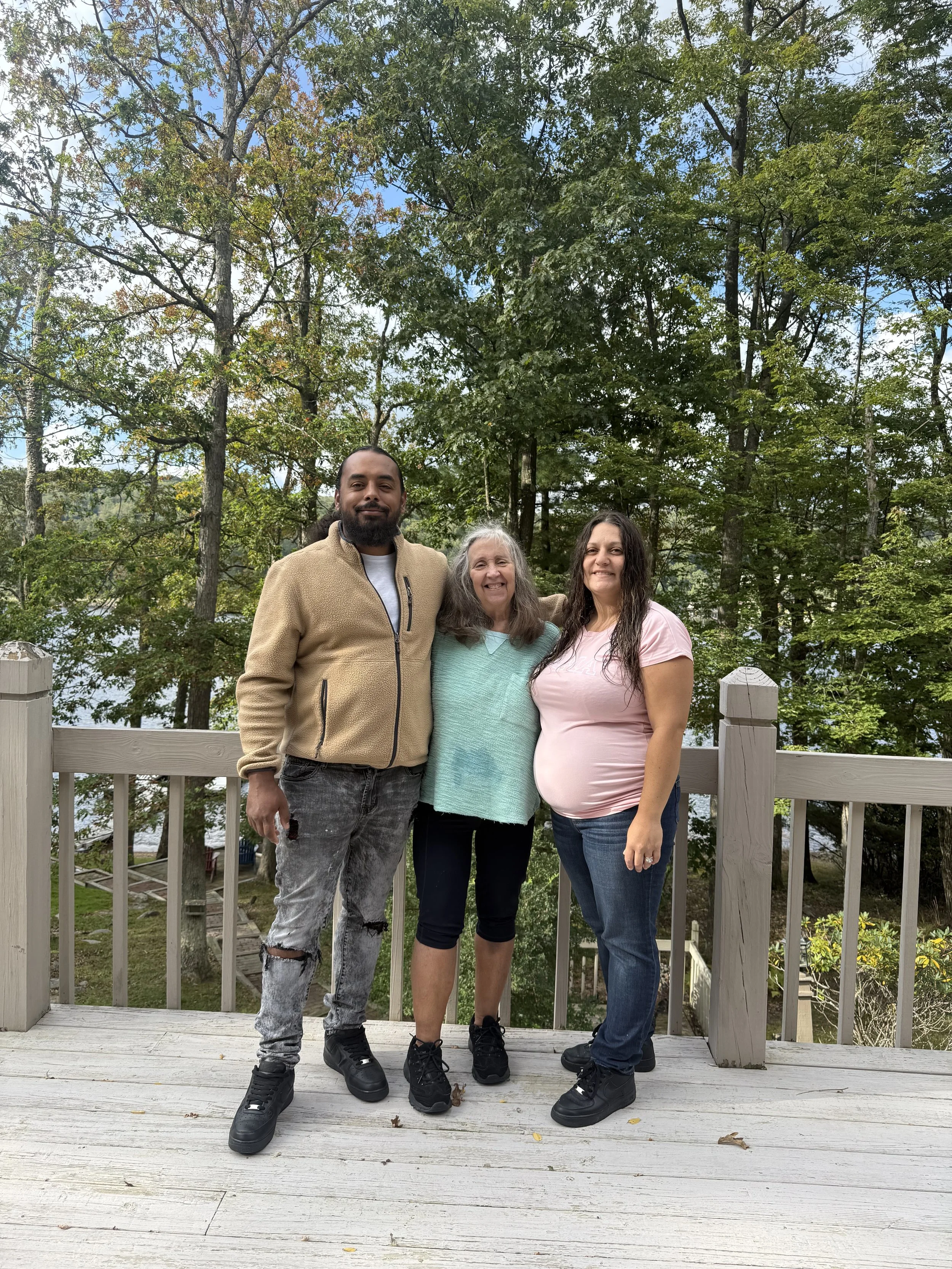
From left to right: Ryan Ewing, Betsy Steinfield, Heather Ewing
A Story About a Convicted Felon, a Former Prosecutor and An Unlikely Friendship
Ryan was a 31-year-old convicted felon, who ran the streets of Wood County as a kid, abandoned by a father he never knew and weighed down by a legacy of family addictions and dysfunction, along with the institutional racism he endured as one of the only kids of color in his community. He says he never really felt like he “had a place in the world” and that he was somehow “less than” the people and the world him. Nothing in his life made him believe that he had any potential worth or value, and he found his “safety in hiding from the world.”
His run-ins with the law started when he was an adolescent, and he was in and out of juvenile facilities multiple times between the ages of 14 and 18. Not surprisingly, the combination of a lack of belief in his self-worth and his attempts to hide from the world led to hopelessness, desperation, substance use, and a lifestyle of bad choices. He was dealing drugs and committing crimes to support his own addiction. Eventually, at the age of 29, he ended up in prison, with little hope for himself or belief in a positive future.
Ryan left prison two years later, with $70 in his pocket, no job, no home, no ID, and with only his prison khakis and a pair of black boots - but nonetheless determined to keep the promise he made to his son that things were going to change - that he would be there for his son, to be a part of his life, and never return to prison. After a few disheartening weeks at a homeless shelter in Charleston, and with a lot of persistence, he managed to achieve his first goal of getting into Lazarus House in Wheeling so that he could continue working toward his recovery and be near his son.
On the other side of the divide, I was nearly 70 years old and a veteran federal prosector, who, at the time, was running the West Virginia state prison system where Ryan was incarcerated. We met for the first time when Nic Cochran, Director of the YSS Recovery Homes, brought Ryan to a meeting of reentry-invested stakeholders at a Starbucks in Charleston, where we were brainstorming about the recurring roadblocks and challenges faced by former prisoners tying to obtain state IDs. As someone who was currently experiencing this exact problem, Ryan’s lived experience was valuable, and he immediately engaged with the group, offering insights and a lived perspective. Ryan and I would soon find out that we had more in common than we did dividing us. He was ready to change and encouraged by the opportunity to use his story to help others. My commitment to reentry had followed a different trajectory, but with the same end goal.
During my time as a prosecutor, I had been tasked with serving as the Reentry Coordinator for the Northern District of West Virginia as part of President Obama’s national reentry initiative. The job had become mine by default. An initiative that contemplated positive and helpful interactions with “convicted criminals” received a lot of nationwide pushback from prosecutors who complained that it was not their job to worry about what happened to sentenced individuals once they went away to serve their time. But the experience of interacting on a personal level with the kinds of people my office had been prosecuting and with whom we were “negotiating” plea bargains that contemplated enhanced and lengthy prison sentences, completely changed my outlook and my opinions about the criminal justice system. It was an opportunity that most prosecutors and judges never have.
Typically, the last time a prosecutor sees a criminal defendant is on what is often that person’s worst day - the day he or she is sentenced. And all too often all we ever know about these people is the worst thing they have ever done. Once a case is over, prosecutors – and judges too – generally move on to the next case, and have little to no further involvement with sentenced individuals. The experience forced me to see something that I was so close to – but at the same time, completely oblivious to - namely the far reaching and often tragic consequences of a criminal conviction. The image of the sea of young faces – mostly men of color, forgotten and rejected – that I encountered on my first visit inside the walls of a federal prison, many of whom would likely be in prison longer than I would be alive (I was in my 40s at that time) is one that I carry to this day. I still blame myself for not knowing or recognizing what was happening at the time. I was a part of it. And while I still believe that everyone should be held accountable, I also believe in second chances and giving those behind bars a fighting chance for success.
Every day I saw overwhelming proof that in so many cases the incarcerated men and women I was meeting were not the same people they were when they went in. They were committed to changing their lives – and the lives of others – for the better. The experience set me on a path and fostered my determination to use the opportunity to open my eyes, try and make meaningful differences and, in the process, change mindsets on both the inside and the outside.
It was this desire to have a more direct impact on successful reentry that drove me to accept the appointment as the Commissioner of the West Virginia Division of Corrections and Rehabilitation. Eventually, the ongoing challenges and disagreements with the powers-that-be over funding, priorities, programming and medical needs of the incarcerated population, led to my return to Wheeling. I reconnected with UpLift West Virginia at the MOJO (Mother Jones Center for Resilient Community), where I found Ryan, working hard at, among other projects, (coincidentally) helping people coming home from prison to get their IDs. He was a man with a mission.
From the time Ryan landed in Wheeling he has dedicated his life to making a difference. Working with youth and the greater community has given his life meaning, and fortunately for all of us, he has finally found his “place in the world around him.” His life experience enables him to serve a greater purpose, and by telling his story and encouraging others who are facing similar challenges, he is living proof that one can become a role model, family man, and community leader after prison.
He and I have spent countless hours together on special projects and extra efforts, such as the prison art initiative, projects for neighborhood youth, recovery events, community aid, education awareness, and reentry simulations throughout the state. After five years of AmeriCorps Service, Ryan continues to be a mainstay at the MOJO, serving as UpLift West Virginia’s Community Educator. An accomplished artist himself, Ryan is also UpLift’s Curation Team Lead, helping to make sure that "artmaking " is a voice for engaging social issues and a space for community dialogue and education. His work has also been displayed at reentry seminars and conferences. He is a facilitator for various youth art programs and is the lead curator and docent for the Inside Out incarceration installation, a collaborative arts project between incarcerated artists in the WV Division of Corrections and Rehabilitation and UpLift WV, exploring the intersections between trauma, addiction, incarceration and reentry. My work on this project began when I was Commissioner. It remains near and dear to my heart, and I am invested in its continued growth and success. Because of Ryan’s virtually guided tour, as our flyer states, the outside world can "explore the humanity” of incarcerated individuals who are "using their abilities to put good in the world even while excluded from it.” The exhibit creates a space for real dialogue about issues of mass incarceration, stigma, homelessness, addiction, recovery, trauma, forgiveness, and the need for reform in both our judicial and penal systems. Ryan is also part of the MOJO team that creates an annual community participatory installation project which is displayed in Washington, D.C. at the Ignatian Solidarity Network Teach-ln.
Ryan’s work and commitment have been so extraordinary that in July of 2025, the LifeBridge AmeriCorps Program announced the creation of the annual Ryan Ewing Award, in his honor, to recognize AmeriCorps members “who go above and beyond in their service, uplifting others with energy, passion, and commitment” in the same way that Ryan has throughout his time with AmeriCorps. He will graduate from college this spring, becoming the first in his family to do so. He serves as President of the Board of Directors for Appalachian Outreach, a non-profit dedicated to easing the burdens of poverty by providing direct services and goods to those in need. He also was instrumental in the creation and development of the local Reentry Navigator Program.
Perhaps his most personally gratifying accomplishment is the way in which he has dedicated himself to fulfilling his family roles as husband, father, brother, uncle and provider. He and Heather were married in October 2023, and I was beyond honored when they asked me to officiate their wedding. He has gained custody of his teenage son, fulfilling his promise to make up for lost time and be a part of his son’s life. He has also adopted his teenage nephew, and both boys now reside with Ryan, Heather, and the newest addition to the family, Caezar Amir Ewing, born this year on January 26th. His commitment to being the role model he never had and to assuring that his legacy is one his family can be proud of, as they move forward together, is nothing less than inspiring. I am grateful and blessed to know Ryan, not only as a co-worker, but also as a friend, He is, for so many of us, a positive and encouraging reminder as to why we keep trying so hard to change a culture that often seems unchangeable.
The criminal justice system, as we know it, surely isn’t designed to foster friendships between those who have broken the law and those who are charged with enforcing it, or between those who have been formerly incarcerated and those charged with overseeing their incarceration. I’m sure the likelihood of Ryan finding common ground and forging a friendship with a former prosecutor and corrections official is not one which many people would have anticipated, but it demonstrates how far we both have come in our journeys of discovery and also that change is possible on both sides of the divide. In a system designed to keep us separated and at odds, we chose to connect, and what we found when we looked past the labels was an unexpected friendship and partnership.
Earlier this month Ryan and I attended a training for keepers of restorative justice circles, and as we sat in a circle with the other participants, I couldn’t help but reflect how both of us have come full circle in our journeys - to a place and a friendship that defies the odds set up by the system to keep us apart and uniformed about the perspectives, worth and value of the other. I have many friends who share histories like Ryan’s. I know that I have learned more from incarcerated populations, and formerly incarcerated individuals, than I have ever imparted to them – on so many fronts. My life is so much richer because of these friends, who, along with their spouses, partners, children, parents and grandparents, have taught me so much and enriched my life in so many ways.
If finding common ground and shared purpose can unite a convicted felon and a former prosecutor, then surely there is hope for all of us. I am proud, and filled with love, to call Ryan my friend. We continue to support and learn from each other. We can always do better, and we know there is still much work to do. For all of us.