
The Camp Closure — What’s Next?
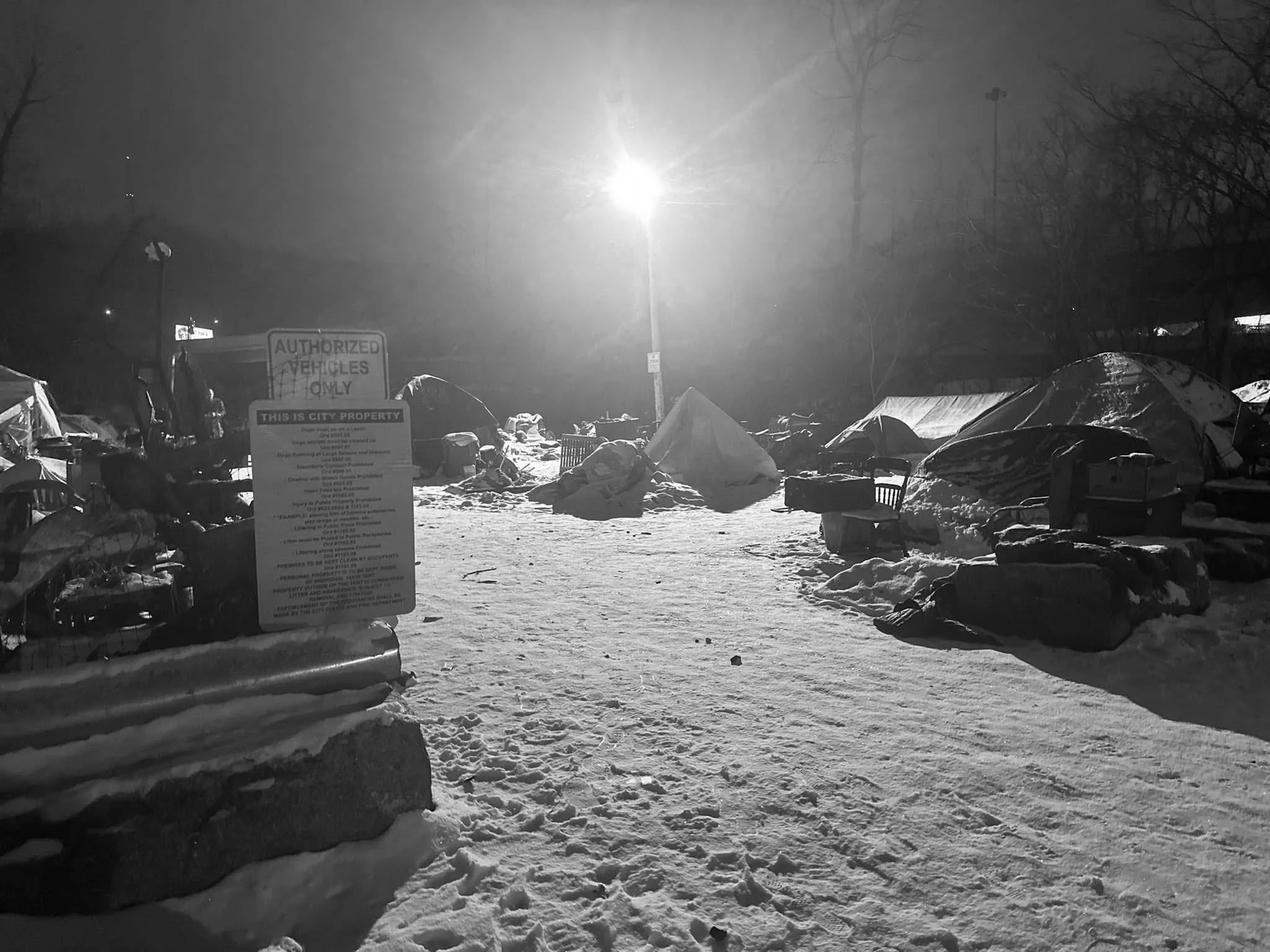
Photo courtesy of Ryan Ewing
It is nearly six months since Wheeling closed its exempted homeless camp in freezing December temperatures, displacing around sixty individuals. Some former camp residents are now in permanent housing, but many more are staying in abandoned buildings and local shelters. For certain groups, there is still not a clear path forward. Wheeling’s social service organizations are reflecting on the closure and looking for long term solutions to avoid the same mass displacement next winter.
“Chaotic and Traumatic”
In November 2025, the Wheeling City Council voted to close the Fulton area exempted homeless camp, the only space in Wheeling where public camping was allowed. With just a month’s notice, local organizations and concerned community members rallied against the council’s decision. Many spoke at council meetings, protested and penned their concerns online. Others voiced their support for the camp closure, citing unsanitary conditions at the camp and concerns about crime.
Ultimately, the city moved forward with the closure on December 1, 2025, forcing dozens of unhoused community members out of their homes.
While most residents of the camp vacated in the days leading up to the closure, a handful of people remained the snowy morning of December 2, when a large group of Wheeling police officers – and several local volunteers – arrived on site. Volunteers helped the remaining residents grab belongings and leave before WPD cleared the area and city bulldozers swept the site.
Some people found a place to stay with family or friends, others dispersed and are still stealth camping in spots around Wheeling, and many are living in abandoned buildings – which poses numerous safety risks.
Elizabeth Workman, the director of the Catholic Charities Neighborhood Center, feels that the closure impacted certain groups differently.
“I think the camp closure gave an opportunity for those that were able and willing to proceed with housing to go ahead and take that next step,” Workman said. “For the rest of the population, I think it was just chaotic and traumatic and took a sense of safety away from them."
Some individuals may be considered “unhousable” – they are not able to qualify for or sustain long-term housing due to criminal records, mental health issues, or a number of other barriers. Others are just not interested in traditional housing. These groups were largely left in the lurch by the closure, Workman said.
“That community went from having a place where they could go that was designated a safe area to having to be even more transient than they already are,” Workman said. “That created a level of uncertainty in that population of where they were going to be able to tuck in safely, where they were going to be able to keep their items.”
This was a common immediate challenge for former residents of the camp – transitioning from having a home base to having to carry all of their belongings with them. Many had to significantly downsize.
“We don't have storage [at the LifeHub,] and they had everything they owned with them, so they had to carry it around with them,” Leach said. “That was hard for them to get used to.”
Having to carry everything you own can also make it incredibly difficult to be taken seriously professionally, such as for job interviews or work shifts, noted HoH-Share, Inc. Director Kate Marshall.
The Catholic Charities Neighborhood Center quickly added lockers on site for people to safely store their belongings. They also worked closely with local organizations like the LifeHub – both expanded their hours so people were not left out in the cold for longer than they needed to be. However, having access to a shelter bed at night is far from a long-term solution, and some do not feel comfortable or safe there.
For those who previously lived at the camp and now regularly stay at the LifeHub, there is often a level of skepticism and mistrust, Leach said.
“There's a lot of anxiety because the police officers are here sometimes and they think that they're going to get caught or in trouble,” she said.
Others have past traumatic experiences with law enforcement, such as being removed from an abusive household as a child.
The Solution - “Funding, Funding and Housing”
There was a big push on the part of various social services organizations in town to get as many people into housing as possible following the camp closure. Catholic Charities’ case manager filled out “an influx” of applications, Workman said. They have now helped house around ten people who were formerly living in the camp.
The LifeHub staff also has guests fill out a public housing application when they are admitted, but being able to secure and keep housing remains a challenge for many unhoused people. Most people cannot afford to rent from a private landlord, and others don’t qualify for public housing due to debt from a previous housing situation or prior criminal convictions.
“I think the biggest group for us that is hard to house is the sex offenders because they can't get a job – no one wants to hire them. They can't get into any public housing. Private landlords don't want them,” Leach said. “They've probably been with us the longest and in all reality, they’re actually the best guests we have because they don’t want to break the law and go back to jail.”
Marshall noted that public housing rules do not differentiate between levels of sex crimes. For example, someone who continued a teen relationship that violated the age of consent is treated the same as a violent sexual offender.
Those with other criminal convictions must wait three years from the time of their conviction before they can be accepted into public housing, although this decision may be appealed.
For some of those who left the camp and were able to secure public housing soon after, keeping their unit was a challenge due to the guilt of abandoning friends on the street, particularly after the trauma of the sudden displacement. Leach said several people got into public housing but were soon evicted for hosting unapproved guests.
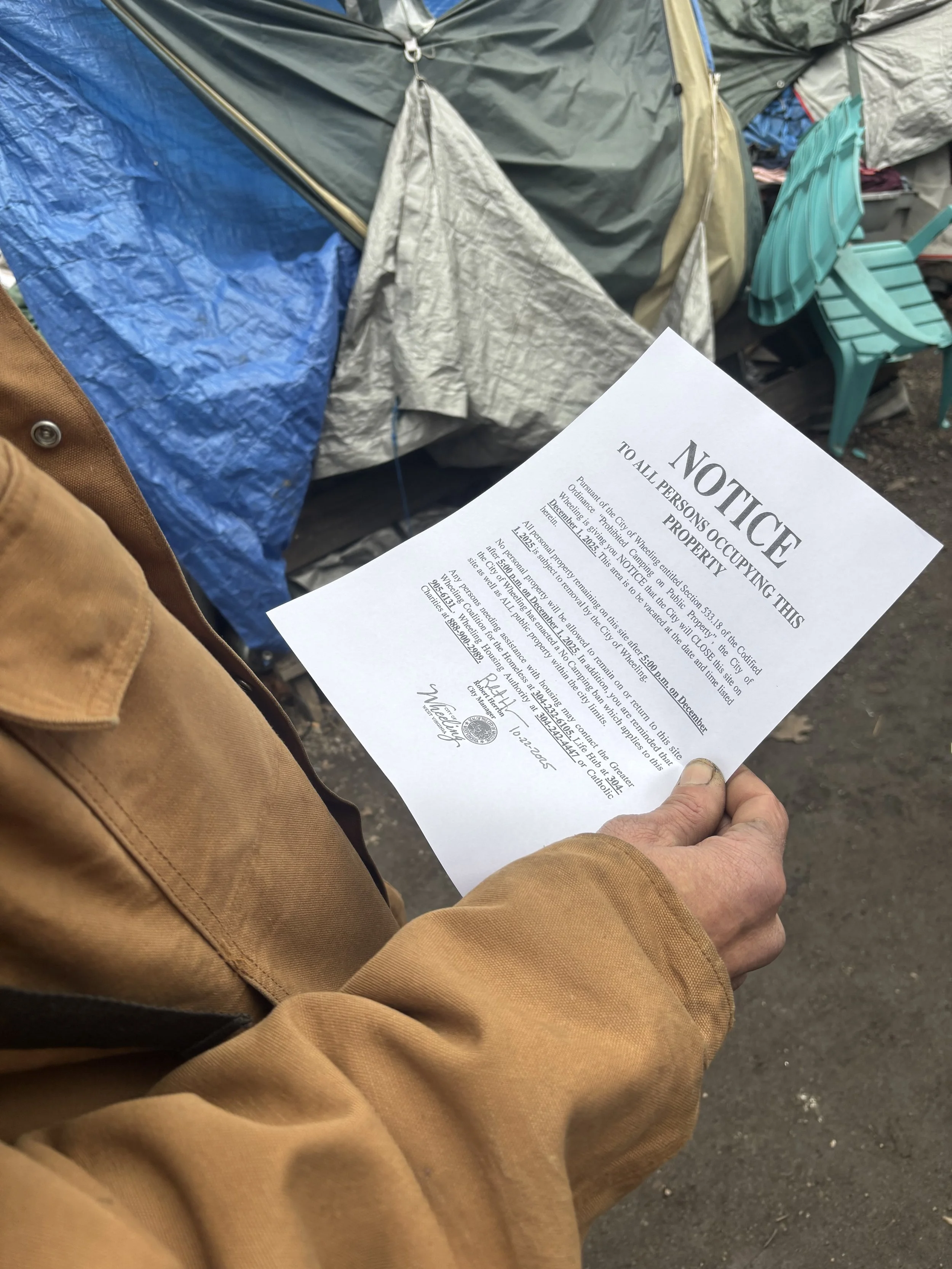
Photo courtesy of Kate Marshall
“When the camp did close, we did have a few of them get into housing who have since lost it because they have that guilt with them, and they had all their friends [staying with them,] and you can't do that because you're going to get evicted,” Leach said.
At the end of the day, the solution to getting people permanently off the street is “funding,” Leach said, “funding and housing.”
Public housing, or HUD, is income-based, government subsidized property rental. Though there are several public housing facilities in Wheeling, space is limited. Waits for entry can be as long as six months or more, and other affordable housing options are sparse. While being unhoused is considered a “preference point” that may help individuals move up the public housing wait list faster than others, there are still a number of barriers that make attaining housing challenging for those who are living on the street.
Director of the Wheeling Public Housing Authority Joyce Wolen said following the conditions of a lease can be a challenge for some individuals who formerly lived on the street. Soliciting neighbors, failing to pay rent on time and having long term unapproved house guests can all be reasons that someone is removed from public housing.
“So people can get themselves into trouble very quickly, not that we want them to,” Wolen said.
For those living on the street, getting approved for public housing often hinges on getting consistent support from social service organizations, Wolen said. Whether it’s assistance with paperwork, mental health support or treatment for substance use, “our social service agencies are critical.”
“Without that support some individuals are not going to be able to just pull themselves out of where they’re at,” Wolen said.
Workman said having more readily available, low-barrier housing options would also immensely help groups who can’t get into public housing. Low-barrier housing removes the typical obstacles – this means things like sobriety, identification and intake processes are not required for entry.
Additionally, recognizing that there is an ongoing mental health pandemic is crucial – “providing more mental health assistance to those individuals could benefit the community,” Workman said.
At the end of the day, assisting those who don’t fit into traditional housing will require honest dialogue and creative solutions, Workman said.
“I really think there just needs to be a realistic conversation about this small group of individuals that are not traditional, and cannot proceed with traditional housing, and what we could potentially do in an unconventional way to help them as well – I think essentially thinking outside the box,” Workman said.
“The Big Picture”
More low-barrier housing, more funding for social services organizations and better access to mental health resources may chip away at the issue of homelessness. But an overarching goal for the local agencies as they work together is changing local mindsets around homelessness, Workman said, noting that dehumanizing language has been normalized.
“One thing that I hear a lot about the Neighborhood Center is that the unhoused like coming here, and same goes with LifeHub and the Soup Kitchen, because they are humanized here,” Workman said. “So I think if the community as a whole humanized their neighbors, it would benefit everybody.”
True change will come from looking at the “big picture” and addressing the root causes of homelessness, Workman said.
"The big picture needs to be fixed. Instead of looking at the unhoused community as ‘vagrants’ or ‘outcasts’ or ‘unwanted individuals in society,’ maybe the conversation needs to be: How did we get here, and how do we help? And how do we make this individual – that is most likely at the lowest point in their life – feel like a human again?”