
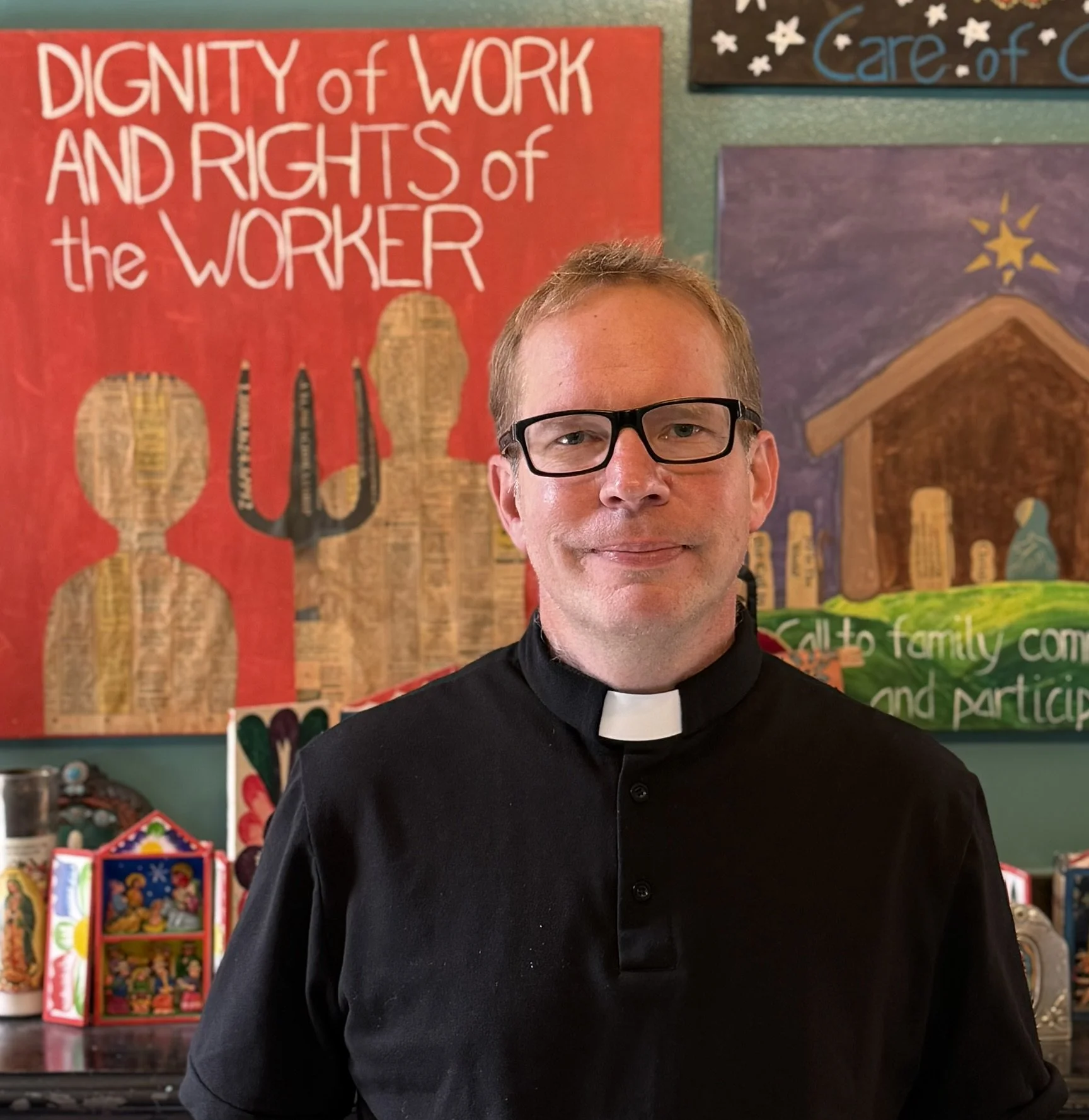
Photo by Kate Marshall
My name is Father Andy Switzer, and Bishop Evelio has appointed me the Delegate for Social Justice and Ecumenism and the Liaison for the Catholic Community of Appalachia.
This past week I was meeting with some leaders at the Mother Jones House, and as we were plotting goodness, they asked me what I had been up to. I told them I had been reflecting on the words of Peter Maurin, one of the founders of the Catholic Worker Movement, who said, "When you do not know what to do, go to a meeting because Pentecost happened at a meeting."
This reminds me of the work of social justice because how many lunches, cups of coffee, and gatherings does it really take to make things happen? This is the Holy Spirit's way of working, bringing people together and giving vision to work for the common good in our community.
We were discussing at the Mother Jones House how oftentimes things seem to move organically. Kate Marshall was sharing with me about the origins of Mustard Seed Mountain, which was really about journalism that treated people with human dignity and honored them and their stories.
Pope Francis has so emphasized to us this culture of encounter. In The Joy of the Gospel he says, "How can it be that it is not a news item when an elderly homeless person dies of exposure, but it is news when the stock market loses two points?" It was not too long ago that the Surgeon General reported that in our country we have an epidemic of loneliness. Dorothy Day's prophetic words remind us that, "We have all known the long loneliness, and the only solution is love, and with love comes community." I am inspired by Father Gregory Boyle, a Jesuit priest who formed Homeboy Industries, which works with those who have been in prison and members of gangs and creates a community of love where true healing takes place. In his work, Boyle says that part of our problem is that we have forgotten that we belong to each other.
We must recognize in our West Virginia history that there are powerful forces of greed that sometimes seek to divide us and create polarization. I recently spoke with Denise Giardina, a historian whose historical fiction may be one of the best ways to study the story of Appalachia. Denise, an Episcopal deacon, has done great ecumenical work over the years with the Roman Catholic Church and other churches for justice in our mountain state. She told me that, knowing the history of West Virginia, she believed Bishop Evelio was the perfect bishop for our state and that El Salvador and West Virginia have many similarities.
I have walked the country roads through the mountains of El Salvador with Bishop Evelio on pilgrimage, and they certainly reminded me of the mountains of West Virginia. The truth is that Appalachia has often had its resources exploited by outsiders. This is also the story of St. Óscar Romero and the Church of El Salvador. But Bishop Romero helped the people rise up and stood for the dignity of every human person.
I believe Pope Leo XIV, who took his name in continuity with Pope Leo XIII, the pope who stood for the rights of workers and for social justice, understands this tradition well. Right here in our mountain state, worker-priests, religious sisters, and laypeople stood against injustice and for the rights of workers and the dignity of every human person.
If we watch the movie Matewan, another great way to study Appalachia, we see a Church of immigrants. As the United Mine Workers came here to organize, they insisted that there could be no discrimination within the union. They recognized that those with money and power wanted to divide them and that, if they were divided, it would be impossible for them to organize and to build a home founded upon the dignity of every human person.
This story is also the story of El Salvador. Wealthy elites sought to exploit the people, but Óscar Romero united the people and chose to lead a prophetic Church that stood for social justice.
This brings us to our technological age and Pope Leo XIV, who has recognized that in our technological world there are often powerful forces that seek to divide us. This is why the culture of encounter is so essential, because when people seek to meet together, we can work for the good of what Pope Francis calls our common home.
I recently went to the soup kitchen, where members of the Homeless Coalition shared a meal with our homeless brothers and sisters. As I listened around the table, people shared their names and their stories. Whoever inspired this endeavor understood something important. As we all shared a meal together, whether homeless, a political leader, a religious leader, or someone working in social services, we were simply sharing a meal and a story.
There were no business items on the agenda, but simply the opportunity to share food and fellowship. This is a witness that we all, by our dignity as children of God, share an equality when it comes to the basic needs of life, such as food and community.
This does not resolve everything, but it is the right way to start.
I am reminded in my own tradition of Jesus and the radical nature of His message, seen in the people with whom He chose to eat and the inclusiveness that He sought to create.
May we all do our part here in Wheeling to create a culture of encounter and remember that we belong to each other.