
The First Handwritten Bible in 500 Years Visits Wheeling




I cried when I first saw and spent time with the Saint John’s Bible. It was the resurrection illumination (the pictures that accompany the biblical text) with Jesus telling Mary Magdalene, and all of us, “don’t hold on to me...”
I’ve always heard crying at art was a thing. My mother and sister, both artists, could regularly get a few tears going on family trips to the Carnegie Museum of Art in Pittsburgh. I’m more of a crier at things like “Les Miserables,” church, and “It’s a Wonderful Life,” always “It’s a Wonderful Life.” But never art. While I like opportunities to evoke an emotional experience, I always wondered, what were they seeing in Monet, or Van Gogh that I was just missing?
So when tears started at the hand painted illumination in the Saint John’s Bible, it finally registered for me.
The Saint Johns Bible - A Handmade Masterpiece
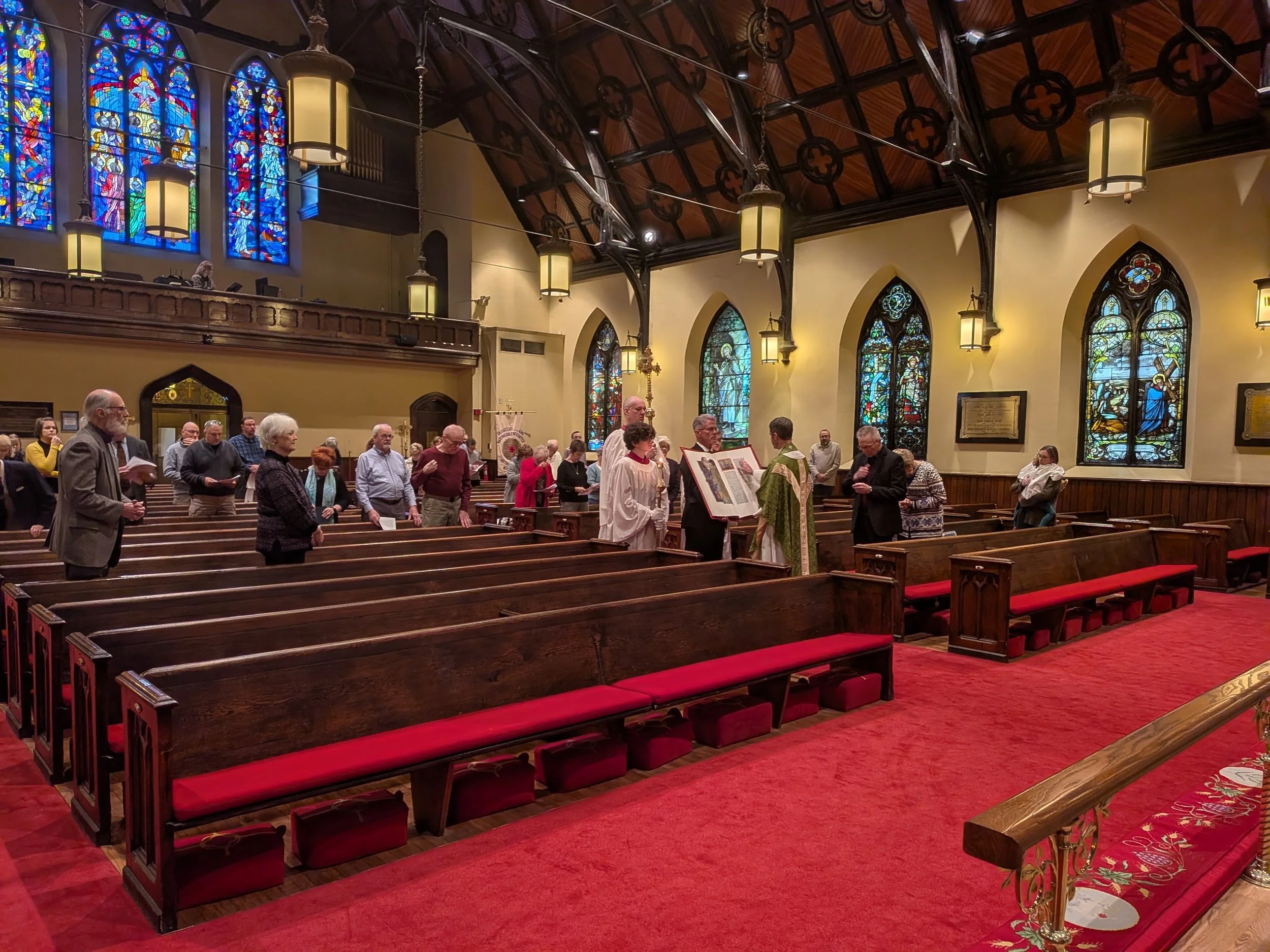
The St John’s Bible is the first handwritten Bible to be produced in 500 years. It was commissioned by Benedictine monks from Saint John’s Abbey in Minnesota, and completed by a team of about two dozen calligraphers and artists, over 13 years as a y2k gift to humanity. It is seven volumes - each BIG, about two feet by three feet large - and about 1,150 pages, including about 70 illuminations. One of the volumes - the Gospels through Acts - has been on loan to St. Matthew’s Church in Wheeling from Lent through Pentecost (until May 24!)
A Mark on Our Human Timeline
The Bible is the most-read, most-published book in human history, and for most of the Bible’s history, it was produced in one painstaking way - by hand. A team of people (usually monks, some of the only literate people in early human society) hand wrote it over a dozen or so years. This made Bibles a few distinct things: rare, difficult to preserve and hyper-intentionally made.
Then, in 1440, Johannes Gutenberg invented the printing press, and again the Bible broke the mold by becoming the first manuscript to be printed on the world-changing device. This both changed and preserved some things about the Bible. It preserved the words, the content, the message that is the Bible - a stellar accomplishment that was one of the primary challenges monks faced over their millenium hand-copying Bibles. Perhaps the primary thing the printing press changed was the number of Bibles in circulation, making the Bible accessible for almost anyone who wanted one in a very short time. Gideon Bible in your hotel drawer, anyone?
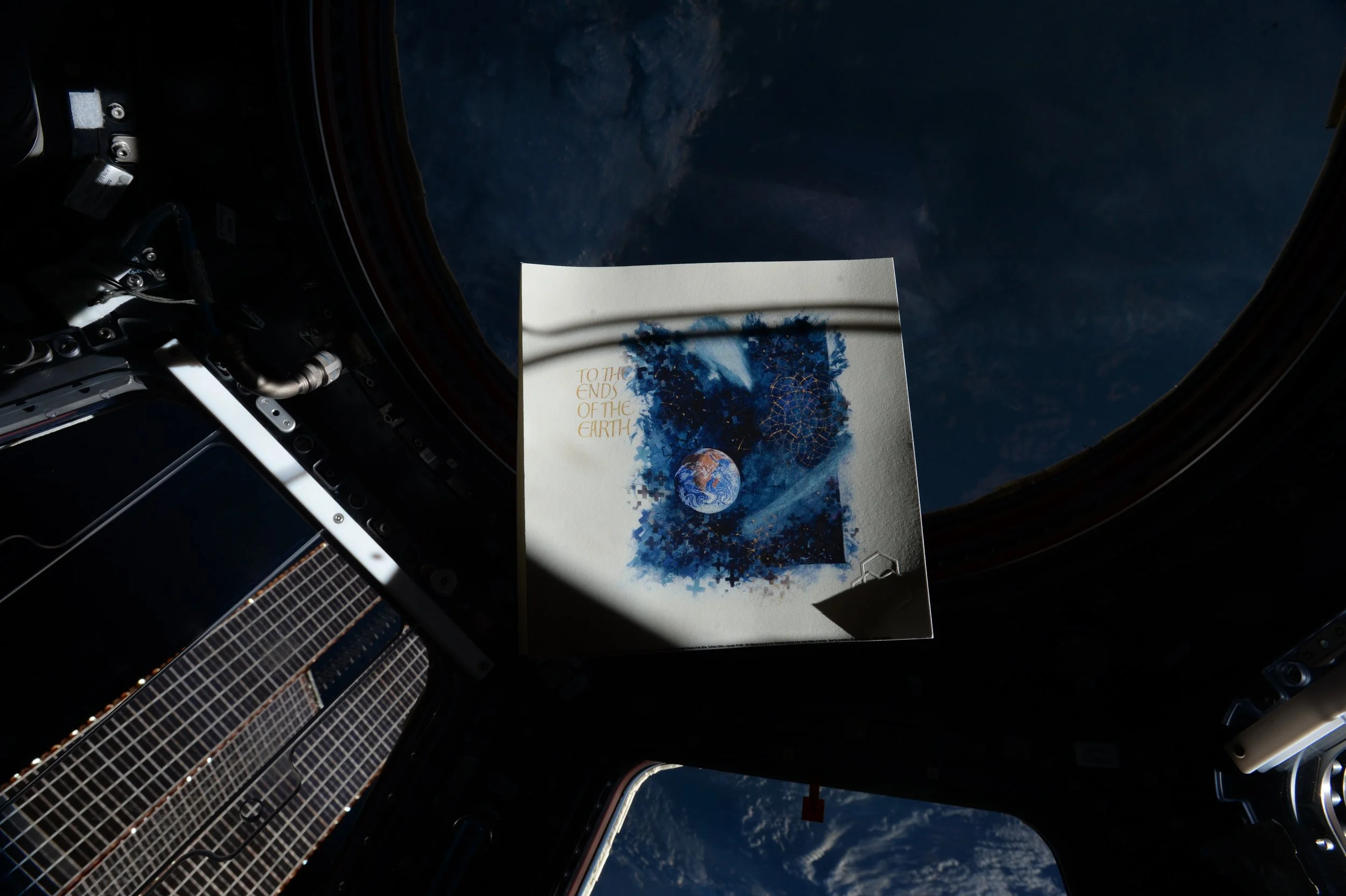
Now 500 years later, are we at a loss for content and sheer magnitude of information? Or are we at a loss for meaning, beauty, and intentionality? This intentionality is exactly what the Saint John’s Bible offers humanity, just as we commemorate our Y2K, internet-information age. They took the Saint John’s Bible to the International Space Station, for goodness sake!
In changing its production from twelve years of hand-writing to one week of mass printing, the intentionality with which Bibles were made also changed. And this is perhaps the most striking and defining attribute of the Saint John’s Bible. Even for life-long church goers who have seen more Bibles and bible stories than there are ’hairs on your head,’ or ‘stars in the sky,’ or ‘sand on the seashore,’ when you look at the calligraphy and illuminations noticeably crafted by, not some piece of machinery, but some fellow human, they register as something else: something meaningful, something intentional indeed. And all the sudden something so familiar, is also a new experience.
A Historic Recreation
The creators of the Saint John’s Bible were committed to replicating as much as humanly possible the same processes monks used to produce Bibles for thousands of years. From the sheepskin vellum “paper,” to the handbound stitching done in Afghanistan, to the calligraphy fonts, to the natural inks, to being commissioned by today’s Benedictine monks whose ancient order has carried on this feat for more than a millenium ago! It is truly incredible the number of people who have preserved these ancient arts and were able to apply them to this first-in-500-year project.
Some Things Have Changed
However, while many things were painstakingly replicated, other things simply can’t be done with the same intention as monks of 500 years ago, because that intention - along with our fashion (except in the case of monks) - has changed in the past 500 years.
For instance, our understanding of the world around us has vastly changed. When Bibles were made 500 or 1,000 or 2,000 years ago, the biblical stories of creation or the genealogies of Abraham, David, and Jesus were the most complete and thorough cosmologies - explanations of our human origin on offer, and Bibles strove to portray them as such.
Today however, in addition to our religious accounts we have scientific cosmologies of the universe, including a ‘Big Bang,’ a heliocentric solar system, a theory of evolution, and modern genetics, which narrate from where our world and lives came.
Therefore, science was one of three topics that the team was deliberate about incorporating our current understanding into the St John’s Bible, the same way previous generations of the Bible creators were deliberate about portraying the world as they best understood it. Along with science, the “role” of women in the Bible, and “marginalized communities” from the biblical narrative were also deliberately updated.
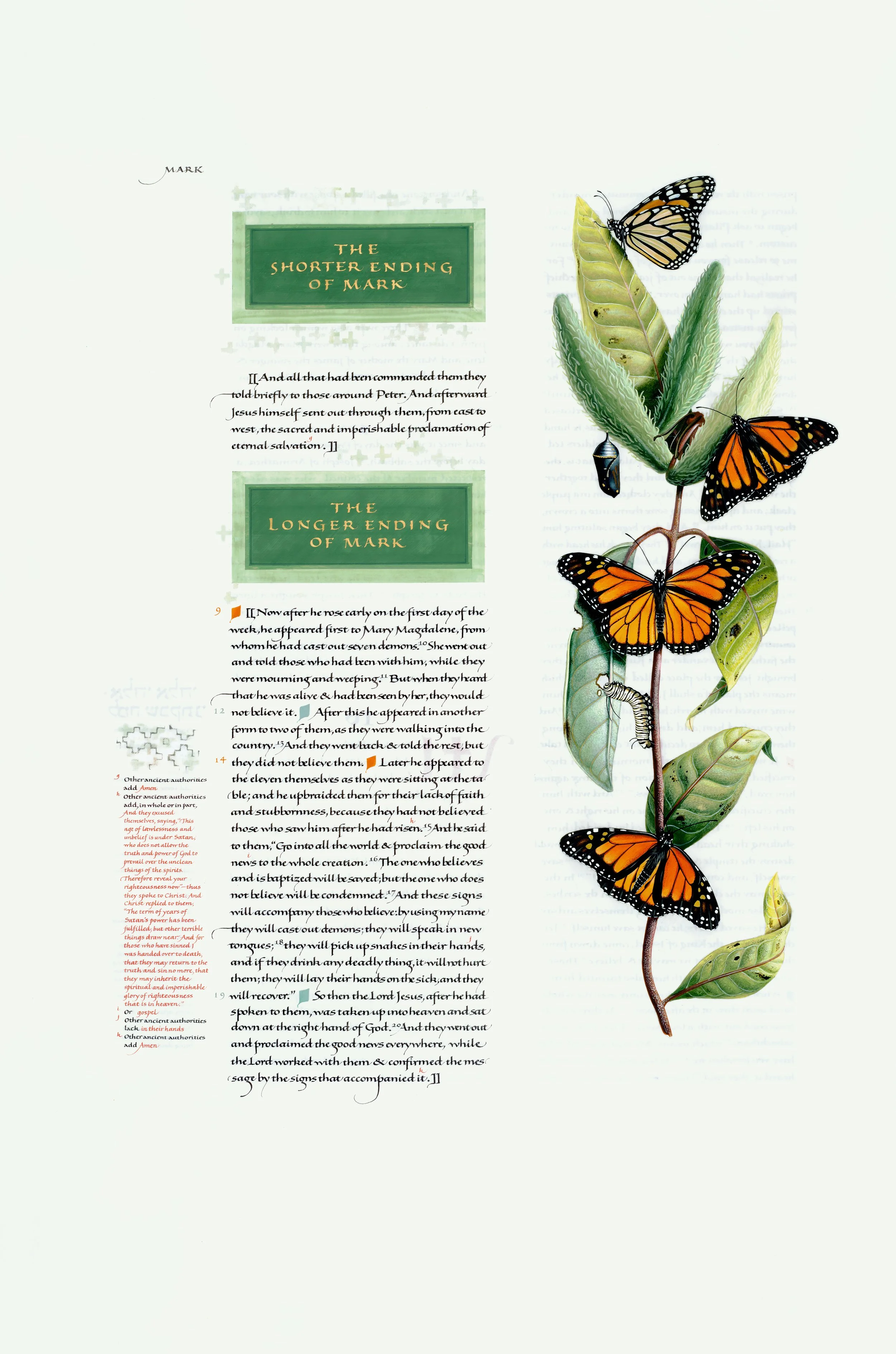
In the pages of the St John’s Bible are anatomically accurate illustrations of butterflies in an ode to creation, double helix gene sequences in the genealogies, and microscopic renderings of the pathogens and plagues featured in the Bible. Jesus’ family tree depicts all the named women in his lineage - even Hagar who as a slave/maid servant is usually omitted (shout out House of Hagar). Depictions of Australian Aborigines and North American Indigenous are also featured in the Creation and Parable of the Sower illuminations.
It’s Beautiful! But Human Hands Do Make Human Mistakes
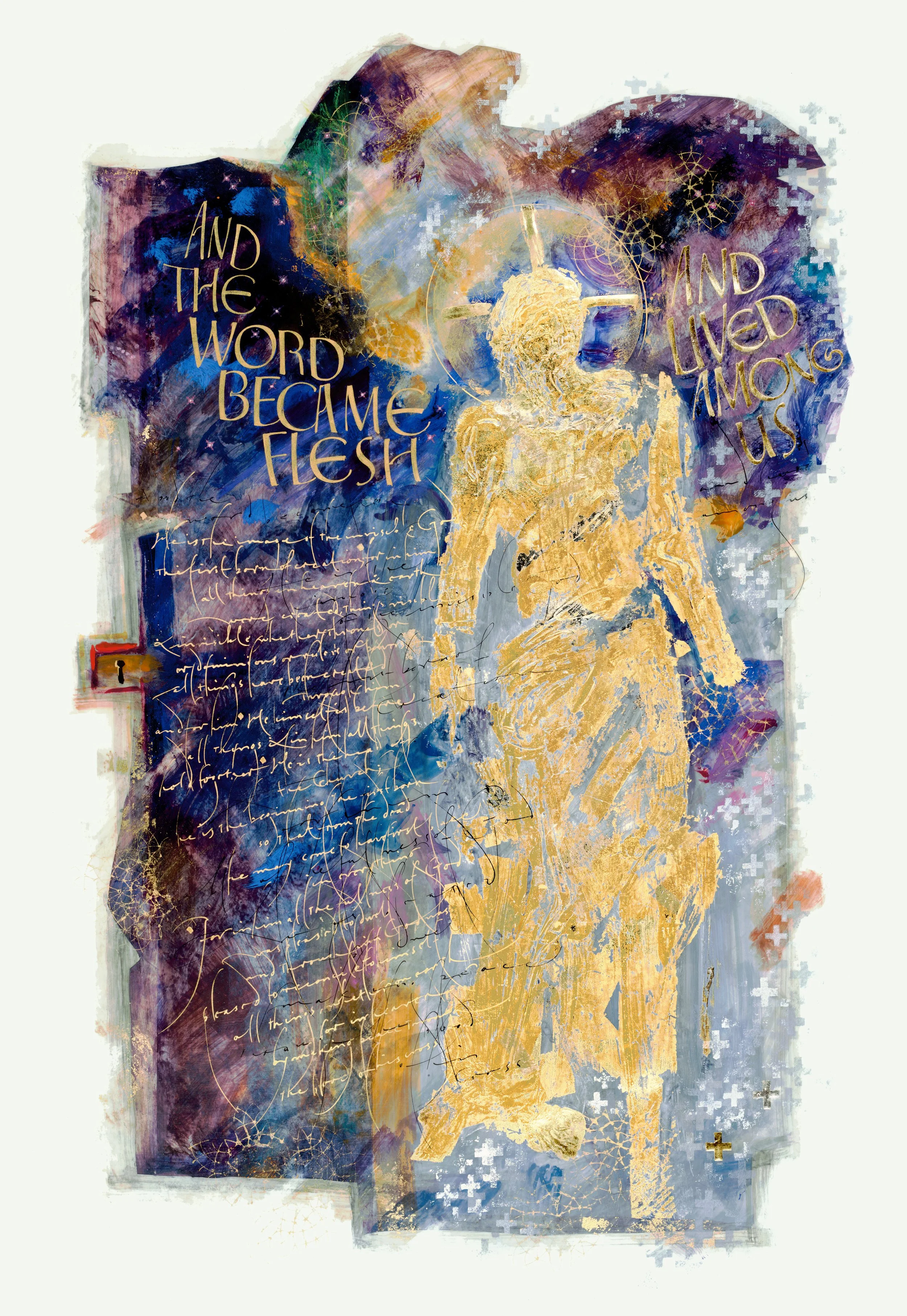
The biblical illuminations are so stunning they recommend praying “visio devina” (divine seeing) like the more common “lectio devina” (divine reading) but with visual art. Where religious art was limited to icons for most of biblical history, we now have a whole array of artistic styles and techniques to express humanity’s experience. So, next to these ancient and medieval iconographic illustrations are ultra modern abstractions of the familiar biblical scenes - the incarnation, the conversation of Paul and the end times of Revelation.
Mistakes, typos, and ‘human errors’ happen when you are making something by hand, and just like the monks of previous millenia, the calligraphers had some fun with them. For instance, perhaps the most common mistake is what’s called a “dropped line,” when the calligrapher accidentally skips one line and goes on to the next – understandable when copying hundreds of thousands of lines of text.
The solution - white out, throw away the whole vellum page, ignore the mistake like nothing happened? No. In keeping with historic methods, the calligraphers would write the skipped line on a scroll down at the bottom of the page, and then call on an illuminator to paint a cherub, bird, or honey bee to fly the the scroll up to where the line should be, or perhaps the line would be lifted into place by a system of da Vinci-style pulleys.
The St John’s Bible - A Book for the Next 500 Years
It is The Book that for millions of people, for the longest span of time, has meant so much – enough to dedicate lives to, to recreate 500 years later for a new millennium to read, pray and worship with, and to enjoy.