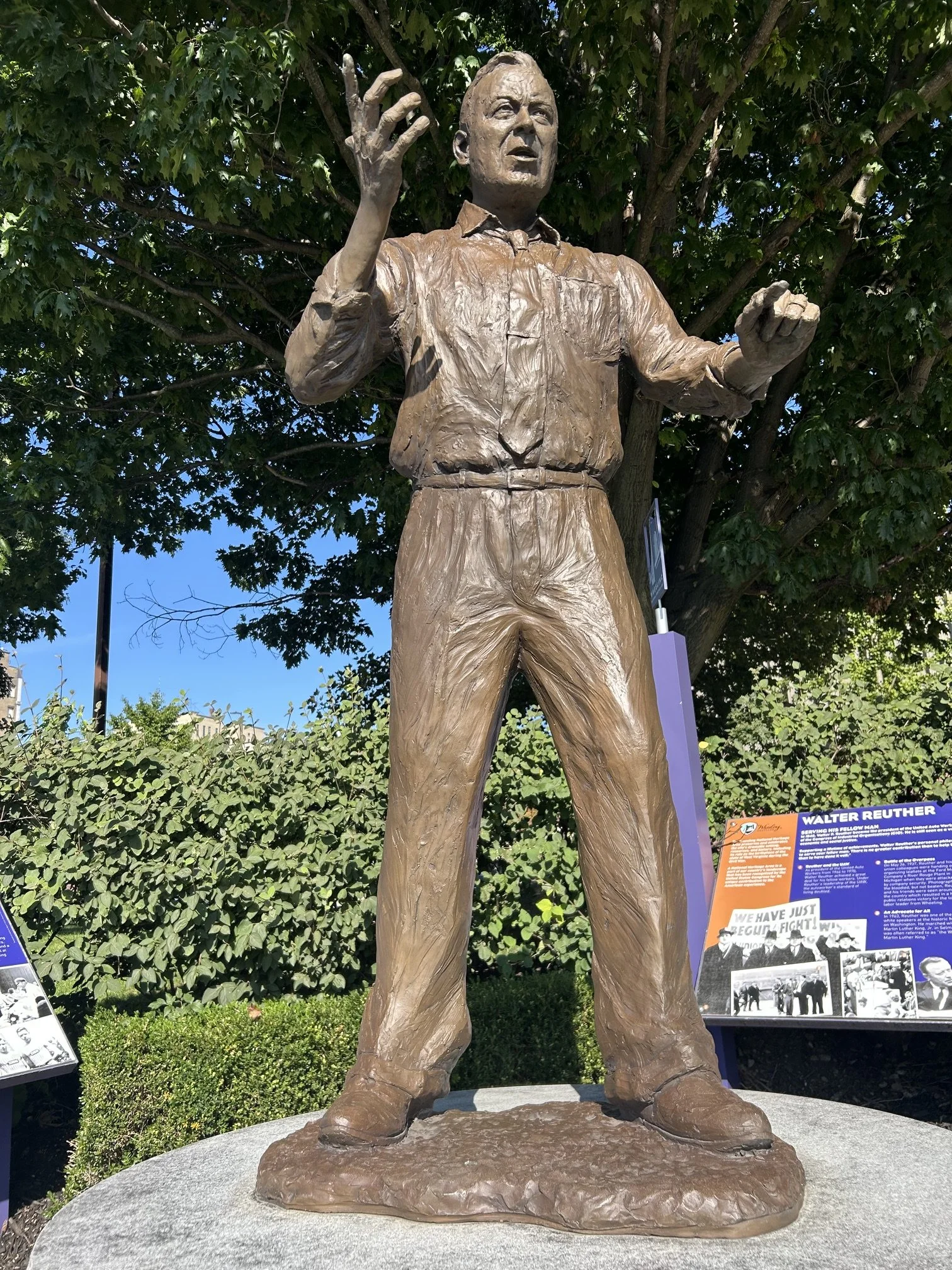
Photo by Niamh Coomey
I was visiting The Mother Jones Center for Resilient Community when a conversation came up about how all people are people, deserving dignity and respect. This led to the mention of Walter Reuther, some of the incredible things that he did in his lifetime, and that he grew up right here in Wheeling, West Virginia. I did not know much about him, but I love to learn, especially about history. I asked if I could write a piece about this Walter Reuther for Mustard Seed Mountain. This endeavor became so fascinating that it has turned into a multi-part series.
If there is one thing I know, it is that people are either defined by – or defy – their past, so I wanted to start by researching Walter’s background. What I found was a rich history not only of the Reuther family but also of the Ohio Valley Trade and Labor Assembly (OVTLA). I found that there were so many incredible people who made the OVTLA a prominent ambassador for equal pay of men and women, women's suffrage, and the eight-hour workday. Furthermore, the organization also took an early progressive stance on race and gender equality. As I learned about just how much the OVTLA did for its community and the social regard it held for all people, I knew I had to write about some of the prominent figures that not only fought for Wheeling and West Virginia’s Labor rights, but who would eventually go on to do so on a national level.
Valentine Reuther: Walter Reuther’s Father
Born in 1881, Valentine Reuther grew up in Edigheim, Germany, where he worked on his family’s farm. In 1892, however, the family immigrated to the United States to avoid the young boys of the family being drafted into the Imperial German Army. Valentine lived with his family for a short time before moving to Wheeling, West Virginia, where his brother Jacob helped him find employment with Riverside Iron Works in nearby Benwood. This was the first time Valentine would experience the working conditions of the average United States laborer. He quickly realized the unjust way employees were treated- long shifts, low wages, and severe safety hazards and he knew they deserved better.
Valentine attempted to start a union at Riverside, but due to a combination of disinterest and his coworkers' worries about unemployment, the union never came to fruition. Valentine decided he needed to leave Riverside Iron Works. He switched jobs to Schmulbach’s Brewing Company. Through interactions at the brewing company, Valentine was introduced to Turnverein, a gymnastics and social association that ran a venue called Turner’s Hall. He gained membership, and one evening during a performance by the Beethoven Singing Society, he met Anna Stocker.
Valentine and Anna hit it off, and it wasn’t long before wedding bells rang in 1904. They moved into an apartment on Jacobs Street where they would end up raising their five children in a heavily German populated neighborhood. Valentine, being the socialite that he was, got to know his neighbors, who also shared a democratic socialist point of view. His cousin Philip, who was also a member of Turnverein, provided Valentine with social literature. Valentine was impressed and immediately wanted to start a Teamsters union at Schmulbach’s.
Now, we are going to take a small detour that will circle us back to Valentine.
The Battle of Homestead
In 1892, Andrew Carnegie was the owner of Carnegie Steel Company, and one of its largest and most successful mills was in Homestead, Pennsylvania. The laborers there were represented by the Amalgamated Association of Iron and Steel Workers union. Carnegie publicly claimed to be pro-labor, but behind closed doors, he was slowly dismantling labor unions across his mills. Several of the surrounding mills owned by Carnegie had their unions dismantled, but Homestead held strong. Carnegie’s contract with the union at Homestead was due to end on July 1st, 1892. Carnegie spoke with Henry Frick, the general manager of the Homestead mill; they were both determined to break the Amalgamated Association of Iron and Steel Workers union.
Carnegie went to visit his native Scotland and gave Frick permission to crush the union whatever the cost, stating, “We approve of anything you do.” Carnegie even threatened to close the plant until the workers gave up their organizing efforts. The laborers and their supporters were already on strike after witnessing what was happening at the other mills. Frick thought he would turn up the heat on the workers by cutting their wages, but the union stood strong and rejected the wage cut. Frick then locked the workers out of the plant and put up a 12-foot barbed wire fence around it. He hired the Pinkerton Detective Agency (a private armed police force) to secretly take over the plant and guard the people who worked in place of the laborers (often referred to as “scabs ”). When the workers caught wind of this, they and their thousands of supporters showed up. The Pinkertons retreated to a nearby barge at the sight of the crowd. The angered crowd did everything they could to blow up the barge, including setting a train car ablaze and rolling it at them to try to sink it.
The Pinkertons and Workers opened fire, starting what became a 12-hour battle that ended with the Pinkertons conceding. Seven workers and three Pinkertons were killed in the fighting. The Pinkertons were forced to exit the barge and were badly beaten by the crowd while being escorted to the local jail. The battle permanently damaged Carnegie’s reputation as an employer and led to something unheard of in Wheeling, WV.
Wheeling Declining the Richest Man in the World
In 1899, Wheeling was offered $75,000 by Andrew Carnegie - then the richest man in the world - to build a Carnegie library in exchange for the city passing a bond levy that would buy the land and cover operating costs. The city was thrilled with the offer, but Valentine Reuther, now a delegate and leader of the Ohio Valley Trade and Labor Assembly, remembered the Battle of Homestead. He, along with his fellow delegates and his brothers and sisters of the unions, would not let Wheeling forget the laborer’s blood spilled because of Andrew Carnegie’s greed. They would remind Wheeling, and the entire United States, that laborers had a voice in government decisions, and they would unite to be heard.
Read more in the next issue to learn about Valentine’s next move, and how it would affect not only his life, but the lives and futures of his children.